Why Surface Treatment Matters: Anodizing vs. Zinc Plating vs. Powder Coating for Safety Hardware
- Share
- Issue Time
- Sep 30,2026
Summary
Compare anodizing, zinc plating, and powder coating for industrial safety hardware. Learn how base materials, corrosion exposure, coating properties, and manufacturing controls affect durability and performance. This guide explains how to interpret salt spray test results—and why test hours alone cannot predict real-world service life.
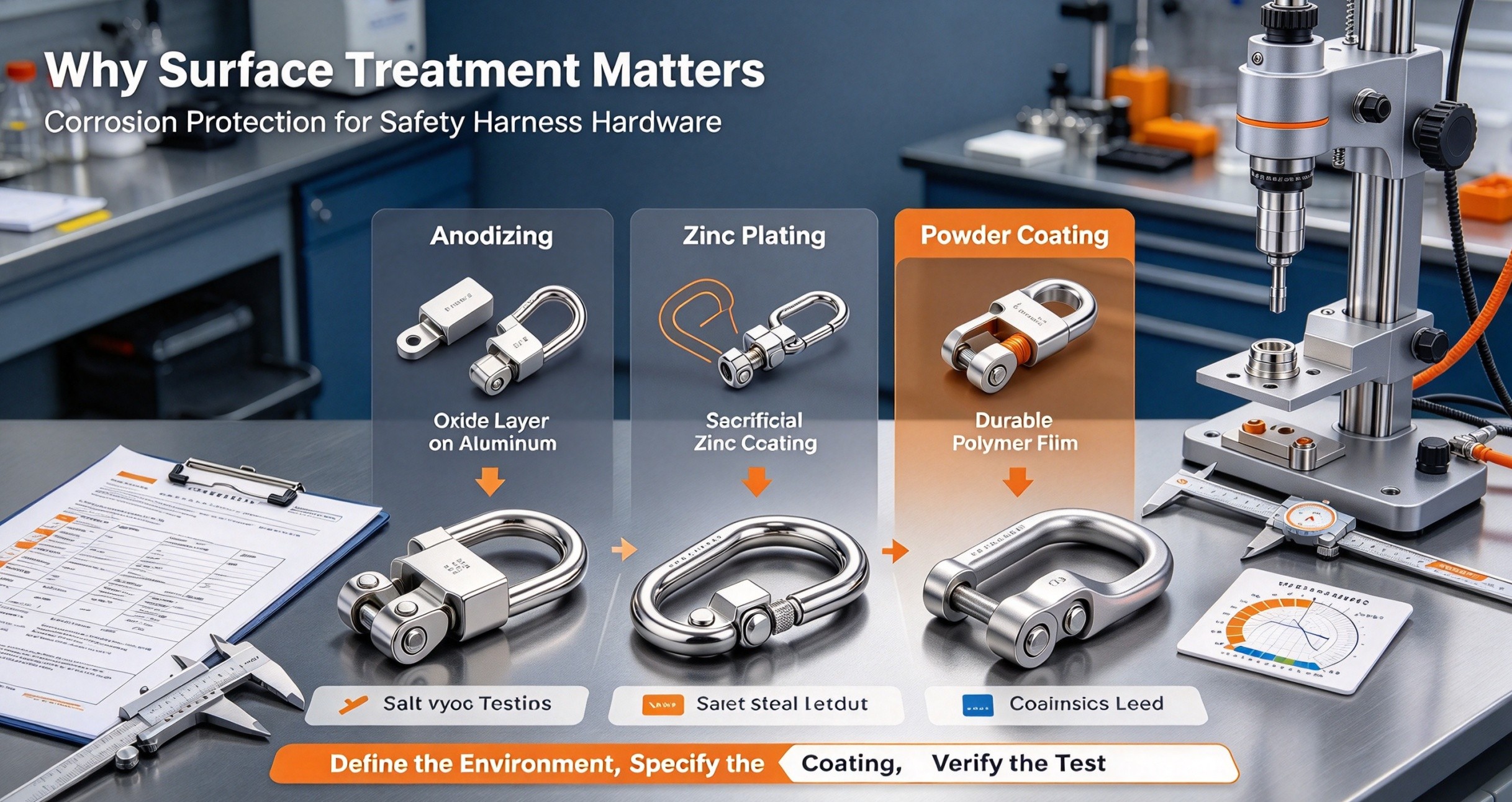
Surface treatment is an important consideration when sourcing metal components for safety harnesses, fall protection systems, rescue equipment, and other industrial applications.
Although material strength and component design are critical, corrosion resistance also affects the durability, appearance, and long-term reliability of metal hardware. Components exposed to moisture, salt, industrial contaminants, or repeated handling may deteriorate if their materials and protective finishes are not properly selected.
For manufacturers of safety harnesses and personal protective equipment (PPE), three common surface treatment options are anodizing, zinc plating, and powder coating.
However, these processes work differently and are not interchangeable.
Anodizing is commonly used to improve the surface properties of aluminum components. Zinc plating provides corrosion protection for suitable steel components. Powder coating creates an organic protective layer that can provide a durable finish on properly pretreated metal surfaces.
Choosing the right treatment requires more than comparing colors or advertised salt spray hours. Buyers must consider the base material, operating environment, mechanical requirements, coating thickness, manufacturing process, and intended application.
This guide compares anodizing, zinc plating, and powder coating to help B2B buyers select appropriate corrosion protection for safety hardware.
1. How Corrosion Environments Affect Safety Hardware
Before selecting a surface treatment, manufacturers should understand the environment in which the finished product will operate.
A coating that performs well in a dry indoor environment may not provide the same protection in a coastal location or an industrial facility exposed to aggressive chemicals.
1.1 Dry Indoor Environments
Hardware used primarily indoors may experience relatively limited exposure to rain, salt, and other environmental contaminants.
Examples include:
Indoor industrial maintenance equipment
Components stored in controlled warehouses
Hardware used in dry manufacturing facilities
Selected indoor positioning and access systems
In these applications, corrosion protection may be less demanding than in outdoor environments.
However, indoor use does not eliminate corrosion risks. Condensation, cleaning chemicals, sweat, and improper storage can still affect metal surfaces.
Buyers should also consider how frequently the hardware will be handled, cleaned, and inspected.
1.2 Outdoor Industrial Environments
Outdoor hardware may be exposed to rain, temperature fluctuations, airborne contaminants, and repeated wet-dry cycles.
Typical applications include:
Construction safety harnesses
Telecommunications tower maintenance
Wind turbine maintenance
Industrial access equipment
Outdoor utility work
In these environments, the protective finish should be selected according to the base material and the expected exposure conditions.
For example, zinc plating may be suitable for certain steel components, while anodizing is a common option for aluminum hardware.
Powder coating may also be appropriate when the substrate preparation, coating system, and component geometry support the required durability.
1.3 Coastal and Marine Environments
Coastal locations introduce a more demanding corrosion environment because airborne salt and salt deposits can accelerate deterioration of susceptible metals.
Potential applications include:
Port maintenance
Coastal construction
Offshore support operations
Marine industrial access
Equipment used near seawater
In these environments, buyers should pay particular attention to corrosion protection at edges, recesses, contact points, and areas where a coating may be damaged.
A coating that looks intact on a flat sample may perform differently on a finished component with holes, bends, corners, and complex geometry.
For aluminum components, an appropriately specified and sealed anodized finish may be worth evaluating. For steel components, the suitability of zinc plating or another qualified coating system depends on the steel grade, finish specification, and exposure conditions.
No single finish should be assumed suitable for every marine application.
1.4 Industrial and Chemical Exposure
Some industrial environments expose hardware to oils, cleaning agents, process chemicals, abrasive dust, or other contaminants.
The effect depends on the specific chemical, its concentration, exposure duration, and operating temperature.
For these applications, buyers should evaluate both corrosion resistance and chemical compatibility.
A coating designed for salt exposure does not automatically provide adequate protection against acids, alkalis, solvents, or other aggressive substances.
Where chemical exposure is expected, request technical compatibility information from the coating supplier and evaluate representative samples under the intended conditions.
1.5 Corrosion Environment Comparison
| Operating Environment | Main Risk Factors | Selection Considerations |
|---|---|---|
| Dry indoor use | Occasional moisture, condensation, handling | Basic corrosion protection may be sufficient, depending on the substrate |
| Outdoor industrial use | Rain, humidity, temperature changes | Evaluate coating durability and protection at edges and recesses |
| Coastal environments | Salt deposits, moisture, repeated wet-dry cycles | Prioritize a qualified corrosion protection system and relevant test evidence |
| Chemical processing | Chemicals, cleaning agents, temperature | Verify chemical compatibility in addition to corrosion resistance |
| High-abrasion applications | Scratches, friction, repeated contact | Evaluate wear resistance and the effect of coating damage |
| Long-term outdoor storage | Weather exposure, condensation, damaged packaging | Consider the complete protection and storage system |
The first rule of surface treatment selection is simple: identify the operating environment before choosing the coating.
2. Anodizing vs. Zinc Plating vs. Powder Coating
Although all three processes can help protect metal surfaces, they differ in their substrates, coating structures, manufacturing requirements, and failure modes.
2.1 Anodizing: A Common Choice for Aluminum Hardware
Anodizing is an electrochemical process that forms a controlled oxide layer on the surface of a suitable metal, most commonly aluminum in industrial hardware applications.
Unlike paint or conventional plating, the anodic oxide layer is formed from the aluminum substrate itself.
This integrated surface structure helps the finish resist peeling or flaking under normal conditions.
Depending on the alloy and process, anodizing can improve corrosion resistance, surface durability, and appearance.
Key advantages of anodizing include:
Suitable for many aluminum components
Improved corrosion resistance when properly processed and sealed
Good resistance to surface wear for suitable anodizing specifications
Options for different colors and appearances
A finish that does not behave like a separate paint film
Anodizing is commonly considered for aluminum carabiners, pulleys, connectors, and other components where weight, appearance, and surface protection are important.
However, the final performance depends on the aluminum alloy, anodizing process, coating thickness, and sealing quality.
Not all aluminum alloys respond identically to anodizing. A color match on one alloy may not be reproduced exactly on another.
Buyers should also consider dimensional tolerances. Because anodizing changes the component's surface dimensions, critical openings, interfaces, and moving clearances should be reviewed during product development.
For fatigue-sensitive or highly loaded aluminum components, the effect of the specified surface treatment should be assessed as part of the engineering qualification process.
Best suited for: Appropriately designed aluminum hardware requiring corrosion protection, controlled appearance, and a durable surface finish.
2.2 Zinc Plating: Corrosion Protection for Steel Components
Zinc plating applies a zinc coating to a suitable steel surface, commonly through an electrochemical process.
Zinc helps protect steel because it acts as a sacrificial coating: under suitable conditions, zinc corrodes preferentially to the underlying steel.
This makes zinc plating a common option for many steel components used in industrial equipment.
Potential advantages include:
Corrosion protection for suitable steel substrates
Relatively thin coatings for applications with dimensional constraints
Options for different passivation and supplementary finishes
A metallic appearance
Potentially competitive cost for suitable production volumes
However, zinc plating performance depends on more than the presence of zinc.
Important variables include coating thickness, pretreatment, passivation, supplementary sealing, surface condition, and process consistency.
For example, zinc corrosion products may appear as white deposits before red rust develops on the underlying steel. White corrosion does not necessarily mean the steel substrate has already rusted, but its significance depends on the product specification and acceptance criteria.
Zinc plating also requires special attention when used on high-strength steel components.
Cleaning and electroplating processes can introduce hydrogen into susceptible steels, creating a risk of hydrogen embrittlement. Depending on the material and applicable specification, risk mitigation may require qualified processing, controlled post-plating baking, and appropriate verification.
For load-bearing safety hardware, the surface treatment process must be reviewed with the component's engineering and quality requirements in mind.
Best suited for: Suitable steel hardware requiring corrosion protection and a relatively thin metallic finish, provided the coating process is compatible with the material and intended application.
2.3 Powder Coating: A Protective Organic Finish
Powder coating applies a dry coating material to a prepared surface, commonly using electrostatic application followed by curing.
The resulting polymer film can provide a durable finish, attractive appearance, and a protective barrier against environmental exposure.
Depending on the coating chemistry and process, powder coating may offer:
A wide range of colors and finishes
Good appearance consistency with controlled production
Useful protection against environmental exposure
Good durability for suitable applications
Opportunities for product identification and visual differentiation
However, powder coating depends heavily on substrate preparation, coating coverage, curing conditions, and film quality.
Poor pretreatment or inadequate coverage can reduce corrosion resistance. Scratches, chips, and damaged edges may expose the underlying metal, allowing corrosion to develop beneath or around the coating.
The thickness of powder coating also matters.
On precision hardware, an excessively thick coating may affect clearances, assembly dimensions, connector interfaces, or moving parts.
For this reason, powder coating should not automatically be applied to every surface of a load-bearing component. Functional areas and contact surfaces must be reviewed, and any treatment used on safety-critical hardware must be validated for the intended design.
Best suited for: Suitable metal components requiring a colored protective finish, particularly when the substrate preparation, coating coverage, and functional dimensions can be properly controlled.
2.4 Comparison of the Three Surface Treatments
| Factor | Anodizing | What Zinc Plating | Powder Coating |
|---|---|---|---|
| Common substrate | Aluminum | Steel | Suitable steel, aluminum, and other compatible substrates |
Important: A D-ring that meets an individual component strength requirement does not automatically make the complete harness compliant. The harness assembly must also meet the applicable requirements.
4. Dorsal, Side, and Chest D-Rings: Which Type Do You Need?
D-ring position determines how the attachment point is intended to be used.
For safety harness manufacturers, selecting the correct location is just as important as selecting the material or manufacturing process.
4.1 Dorsal D-Rings
A dorsal D-ring is positioned on the back of a harness, typically around the upper back between the shoulder blades.
It is commonly used as a fall arrest attachment point.
Typical applications include:
Construction safety harnesses
Industrial maintenance
Elevated work platforms
Roofing and steelwork
General industrial fall protection
The dorsal D-ring must be compatible with the harness design and the intended fall protection system.
When developing a harness, manufacturers should consider its position relative to the user's body, the harness webbing layout, connector clearance, and the system's fall-arrest configuration.
4.2 Side D-Rings
Side D-rings are usually positioned around the hips and are commonly associated with work positioning.
They may be used with a positioning belt or compatible harness configuration to help a worker maintain a working position.
Typical applications include:
Utility pole work
Industrial maintenance
Certain construction tasks
Work positioning at height
Side D-rings are generally intended for positioning rather than fall arrest.
They should not be treated as fall arrest attachment points unless the specific harness is explicitly designed and approved for that use.
For many positioning applications, a pair of side D-rings is used with a compatible positioning system. Buyers must follow the harness manufacturer's instructions for the required connection arrangement.
4.3 Chest or Sternal D-Rings
Chest D-rings, also called sternal or frontal attachment points in some product documentation, are positioned at the front of the harness.
Depending on the harness design and applicable standard, they may be used for specific fall arrest, ladder-climbing, restraint, or other approved applications.
Typical applications may include:
Guided fall arrest systems
Certain ladder-climbing systems
Selected industrial access applications
Specific harness configurations requiring a frontal attachment
The exact permitted function depends on the harness design and certification.
Some harnesses use two frontal attachment elements marked A/2 that must be connected together in the manner specified by the manufacturer. These should not be treated as interchangeable with a single, independently approved chest D-ring.
4.4 D-Ring Position Comparison
| D-Ring Position | Common Intended Application | Important Consideration |
|---|---|---|
| Dorsal | Fall arrest | Verify harness configuration and connector compatibility |
| Side or hip | Work positioning | Do not assume suitability for fall arrest |
| Chest or sternal | Specific fall arrest, ladder climbing, or restraint applications | Verify the approved configuration and attachment markings |
| Shoulder | Certain rescue, retrieval, or specialized applications | Confirm the harness instructions and approved use |
These are general descriptions, not universal permissions for every harness.
The harness manufacturer's instructions, attachment markings, and applicable certification determine the permitted use of each D-ring.
5. Dimensions and Compatibility with Harness Webbing
Even when a D-ring meets the required strength specification, incorrect dimensions can create assembly problems or affect how loads are transferred through the harness.
B2B buyers should evaluate the D-ring as part of the complete harness design.
5.1 Webbing Width and Thickness
The D-ring must accommodate the intended webbing configuration.
Important dimensions include:
Internal opening
Bar diameter or cross-section
Overall width
Overall height
Material thickness
Webbing contact area
Clearance around the attachment point
If the opening is too small, assembly may become difficult or the webbing may fold incorrectly.
If the dimensions are unsuitable, the D-ring may rotate unexpectedly or create uneven loading.
5.2Edge Radius and Surface Finish
The areas contacting the webbing should be appropriately finished.
Sharp edges, burrs, deep scratches, or damaged coatings can contribute to webbing abrasion.
Manufacturers should verify:
Smooth contact surfaces
Suitable edge radii
Consistent finishing
No unacceptable burrs
No visible cracks or deformation
No coating defects that compromise the intended protection
OSHA's construction fall protection requirements also specify corrosion-resistant finishes and smooth surfaces and edges for covered connector hardware.
5.3 Connector Compatibility
The D-ring must work with the connectors intended for the harness.
Buyers should check:
Connector opening dimensions
D-ring cross-section
Potential interference between components
Correct connector seating
Risk of incompatible loading
Whether the connector can rotate or become trapped
Whether the connection arrangement follows the equipment instructions
A D-ring should not be approved based on dimensional inspection alone. Sample assemblies should be evaluated using the intended webbing and connector configuration.
6. Testing and Certification for D-Rings
Testing and certification are essential when sourcing D-rings for safety harness production.
However, the applicable testing program depends on the target market, the type of harness, the component's function, and the product's intended use.
A supplier's test report for an individual metal component is not necessarily evidence that a complete harness design has been certified.
6.1 Static Strength Testing
Static strength testing evaluates the component or assembly under a specified loading procedure.
Depending on the applicable requirement, testing may examine:
Load-bearing performance
Cracking
Breaking
Permanent deformation
Failure location
Changes in dimensions after loading
Buyers should ask which test method was used and whether the reported results apply to the D-ring alone or the complete harness assembly.
6.2 Dimensional Inspection
Dimensional inspection helps confirm that production components remain consistent with the approved design.
Important inspection points include:
Overall dimensions
Internal opening
Cross-section
Thickness
Webbing contact surfaces
Critical radii
Attachment geometry
Factories should define inspection tolerances and use appropriate measuring tools.
6.3 Surface and Corrosion Inspection
Surface inspection should identify defects that could affect durability or compatibility.
Depending on the material and finish, inspection may include:
Visual surface inspection
Burr and edge checks
Coating thickness measurement
Coating adhesion assessment
Corrosion resistance testing
Inspection after environmental exposure
The appropriate test method and acceptance criteria should be established before production.
6.4 Complete-Harness Testing
D-rings used as attachment elements in a full-body harness must be evaluated within the relevant harness design and qualification process.
For the European market, EN 361 addresses full-body harnesses used in personal fall protection systems.
For the U.S. market, ANSI/ASSP Z359.11 addresses the performance, design, marking, qualification, testing, inspection, use, and maintenance of full-body harnesses.
Buyers should confirm the current applicable edition, conformity requirements, and certification route for the intended market.
A change to a D-ring's material, geometry, dimensions, or finish may affect the qualification status of the finished harness. Manufacturers should therefore establish formal engineering approval and change control before substituting components.
6.5 Batch Traceability
Reliable traceability helps safety harness manufacturers maintain consistent product quality.
Suppliers should be able to provide relevant records, such as:
Material identification
Production batch numbers
Manufacturing records
Inspection results
Test reports
Surface treatment records
Nonconformance records
Corrective action documentation
Traceability supports supplier audits, product investigations, and quality management throughout the production lifecycle.
7. How to Evaluate a D-Ring Supplier for OEM Production
For OEM and ODM projects, the supplier's manufacturing capability is as important as the D-ring specification.
Before placing a bulk order, buyers should evaluate the supplier's ability to maintain consistent production and support technical requirements.
Key Questions to Ask
Product and engineering
1. Which D-ring designs and sizes are available?
2. Can the supplier manufacture forged and stamped or formed designs?
3. Which materials and surface finishes are available?
4. Can the supplier review technical drawings?
5. Can dimensions be customized for specific webbing?
Quality and testing
6. What material inspection procedures are used?
7. Which dimensional characteristics are controlled?
8. What strength testing is available?
9. Can test reports be linked to production batches?
10. How are nonconforming components handled?
OEM support
11. Can the supplier develop custom tooling?
12. Can samples be produced for evaluation?
13. Can logos or product identification be added?
14. What documentation can be supplied?
15. How are engineering changes controlled after sample approval?
These questions help buyers distinguish between a supplier that simply sells hardware and a manufacturing partner capable of supporting a long-term safety equipment program.
8. A Practical D-Ring Selection Checklist
Before approving a D-ring for your production line, confirm the following:
| Selection Factor | Questions to Confirm |
|---|---|
| Intended application | Is the D-ring designed for fall arrest, positioning, restraint, or another approved function? |
| Material | Is the material grade appropriate for the application? |
| Manufacturing process | Is forging, stamping, or forming suitable for the design? |
| Strength | Does the component meet the applicable strength requirements? |
| Dimensions | Does it fit the specified webbing and harness configuration? |
| Surface finish | Are corrosion protection and edge finishing appropriate? |
| Compatibility | Does it work correctly with the intended connectors? |
| Testing | Are the required component and complete-harness tests documented? |
| Certification | Does the finished product meet the requirements of the target market? |
| Traceability | Can production and test records be traced to the relevant batch? |
| OEM customization | Can the supplier support approved design changes and custom specifications? |
Completing this checklist before mass production can help reduce compatibility problems, prevent avoidable redesigns, and improve supplier qualification.
Conclusion
Selecting the right D-ring for a safety harness production line requires more than choosing between forged and stamped designs.
Manufacturers must evaluate the material, manufacturing process, strength requirements, attachment position, dimensions, surface finish, connector compatibility, and applicable certification.
Forged D-rings may be appropriate for certain robust or complex designs, while stamped or formed D-rings can offer efficient production for suitable applications. Neither manufacturing method guarantees safety on its own. Verified performance and consistent quality control are essential.
Buyers must also distinguish between dorsal, side, and chest attachment points. Each has a specific intended function, and the approved use depends on the complete harness design and applicable requirements.
For safety harness manufacturers, PPE brands, and fall protection equipment suppliers, working with a capable OEM hardware supplier can simplify component development, improve production consistency, and support the qualification of finished products.
The best D-ring is not necessarily the heaviest, strongest-looking, or least expensive option. It is the component that meets the required specifications, integrates correctly into the harness, and performs reliably in its intended application.
Call to Action
Ask for D-Ring Customization Options
Are you developing a new safety harness or looking for a reliable D-ring supplier for your existing production line?
We support B2B customers sourcing fall protection hardware for industrial safety harnesses, work positioning systems, rescue equipment, and related PPE applications.
Our customization options may include:
Different D-ring dimensions and geometries
Forged and stamped or formed designs, depending on requirements
Steel and other suitable material options
Customized surface treatments
Webbing compatibility evaluation
OEM branding and product identification
Sample development
Technical documentation and testing support
Contact our team to discuss your application and request D-ring customization options for your next safety harness production project.
Provide your drawings, webbing specifications, target market, and applicable standard so that we can evaluate the most suitable hardware solution for your requirements.