Understanding Minimum Breaking Strength (MBS) and Working Load Limit (WLL) in Safety Connectors
- Share
- Issue Time
- Jun 23,2026
Summary
This article explains the key differences between Minimum Breaking Strength (MBS) and Working Load Limit (WLL) in safety connectors used for fall protection systems. It covers safety factors, product markings, load testing examples, and practical selection tips for B2B buyers, PPE brands, and safety harness manufacturers. Learn how to evaluate connector strength ratings, testing reports, and supplier reliability before mass production.
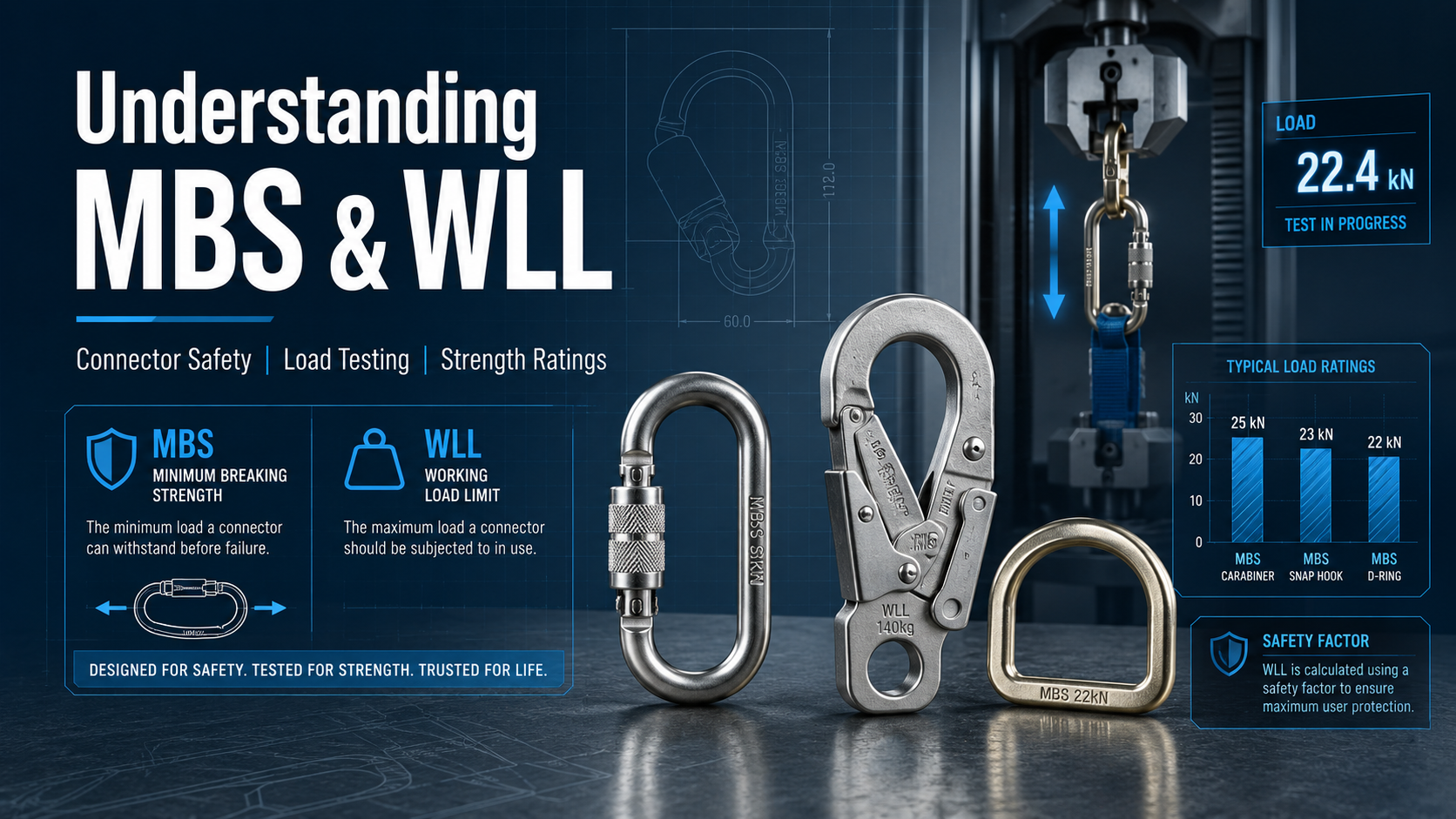
In industrial fall protection systems, every connector carries a serious responsibility. Whether it is a carabiner, snap hook, D-ring, adjustable buckle, rope grabber, ascender, descender, or pulley, the connector must perform reliably under load and help protect workers during work-at-height operations.
For B2B buyers and safety harness manufacturers, two load-related terms are especially important: Minimum Breaking Strength (MBS) and Working Load Limit (WLL).
Although these terms are often used together, they do not mean the same thing. Confusing MBS with WLL can lead to incorrect product selection, unsafe system design, certification problems, and serious field risks.
This guide explains the differences between MBS and WLL, how factories calculate safety factors, why product markings matter, and how real load testing helps buyers evaluate connector quality before mass production.
1. What Is Minimum Breaking Strength (MBS)?
Minimum Breaking Strength, often abbreviated as MBS, refers to the minimum force a connector is expected to withstand before failure under controlled test conditions.
In simple terms, MBS answers this question:
“At what minimum load should this connector not break?”
For example, if a steel carabiner is marked with 25 kN MBS, it means the connector is designed and tested to resist at least 25 kilonewtons of force before breaking under the specified test direction and method.
MBS is usually used for:
Carabiners
Snap hooks
D-rings
Buckles
Rope grabbers
Pulleys
Descenders
Other fall protection hardware
MBS is not the same as the load that workers should use every day. It represents a failure threshold under controlled testing, not the recommended operating load.
Why MBS Matters
MBS is critical because fall protection equipment may experience sudden impact forces during a fall arrest event. Unlike ordinary lifting or static loading, fall protection systems must handle dynamic forces generated by a falling worker.
A higher MBS generally means the connector has a stronger structural design, better material performance, and greater resistance to extreme loads. However, MBS alone does not determine whether a connector is suitable for a specific application. Buyers must also consider standards, gate strength, material, locking mechanism, compatibility, and working conditions.
2. What Is Working Load Limit (WLL)?
Working Load Limit, or WLL, refers to the maximum load that a product is designed to handle during normal use.
In simple terms, WLL answers this question:
“What load can this product safely support in regular working conditions?”
WLL is commonly used in lifting, rigging, hoisting, anchorage, and industrial load-handling applications. It is typically lower than MBS because it includes a safety margin.
For example:
If a connector has a breaking strength of 25 kN and the required safety factor is 5:1, the working load limit would be:
25 kN ÷ 5 = 5 kN WLL
This does not mean the connector will break at 5 kN. It means 5 kN is the recommended safe working limit under the defined conditions.
Why WLL Matters
WLL helps engineers and safety managers select components for real-world applications. It accounts for factors such as:
Repeated use
Wear and abrasion
Shock loading
Incorrect angles
Environmental exposure
Human error
Material fatigue
For fall protection products, WLL may not always be the primary marking shown on the connector. Many PPE connectors are marked by MBS or strength rating instead. However, understanding WLL is still valuable for engineers who design systems involving lifting, suspension, rescue, or load transfer.
3. MBS vs WLL: What Is the Difference?
The key difference is this:
MBS is the minimum breaking point. WLL is the safe working load.
MBS tells you how much load the connector should withstand before failure in a test. WLL tells you how much load the connector should carry during normal operation.
Comparison Table
| Factor | MBS | WLL |
|---|---|---|
| Full name | Minimum Breaking Strength | Working Load Limit |
| Meaning | Minimum force before failure | Maximum safe load during use |
| Used for | Strength rating and testing | Daily working load guidance |
| Value | Higher | Lower |
| Includes safety factor | Not always directly | Yes |
| Common in | Fall protection, PPE, climbing, rescue | Lifting, rigging, hoisting, load handling |
| Buyer concern | Can it withstand extreme force? | Can it be safely used under normal load? |
Example
A snap hook may have:
MBS: 25 kN
Safety factor: 5:1
Estimated WLL: 5 kN
This means the snap hook is tested to withstand at least 25 kN before failure, but its recommended working load under a 5:1 safety factor would be 5 kN.
For safety harness manufacturers, both numbers are useful. MBS helps evaluate compliance and ultimate strength, while WLL helps assess safe use in specific operating conditions.
4. How Factories Calculate Safety Factor
A safety factor is the ratio between breaking strength and working load limit.
The basic formula is:
Safety Factor = MBS ÷ WLL
Or:
WLL = MBS ÷ Safety Factor
For example:
| MBS | Safety Factor | WLL |
|---|---|---|
| 20 kN | 4:1 | 5 kN |
| 25 kN | 5:1 | 5 kN |
| 30 kN | 5:1 | 6 kN |
| 40 kN | 5:1 | 8 kN |
The correct safety factor depends on product type, application, standard requirements, industry practice, and risk level.
Why Safety Factor Is Necessary
In real working environments, connectors are rarely used under perfect laboratory conditions. They may be exposed to:
Side loading
Gate loading
Twisting
Dirt and sand
Salt spray
Temperature changes
Repeated opening and closing
Abrasion from ropes, webbing, or metal structures
A safety factor creates a buffer between the normal working load and the breaking point. This buffer helps reduce the risk of failure caused by unpredictable field conditions.
Factory Considerations
When designing safety connectors, professional manufacturers evaluate:
Material grade
Heat treatment process
Forging or CNC machining accuracy
Surface treatment thickness
Gate and locking structure
Load direction
Expected use environment
Applicable standard requirements
For example, a steel snap hook designed for heavy-duty construction may use a different safety factor and testing approach than an aluminum carabiner designed for lightweight rope access.
5. Why B2B Buyers Must Check Product Markings
For safety harness manufacturers and PPE brands, product markings are not just small engravings. They are part of product compliance, traceability, and user safety.
A professional connector should clearly show key information such as:
Manufacturer name or logo
Model number
Batch number or traceability code
Strength rating
Standard reference
Load direction marking
Material or product category
Production date or inspection reference, when required
Why Markings Matter
Product markings help buyers and end users confirm that the connector matches the intended application. They also support inspection, quality control, and after-sales traceability.
If a connector has no clear markings, buyers may face several risks:
Difficulty verifying strength rating
Higher risk of using the wrong product
Problems during certification or audit
Reduced trust from end users
Increased liability in case of failure
For OEM safety harness brands, incorrect or incomplete markings can delay product approval and damage brand reputation.
Common Marking Mistakes
Some low-quality suppliers may provide connectors with:
Unclear laser engraving
Missing MBS value
No batch number
Wrong standard reference
Inconsistent markings between samples and mass production
Markings that disappear after coating or polishing
These problems are not just cosmetic. They can create real compliance and safety concerns.
A reliable supplier should provide consistent markings across every production batch and be able to match each marking to material records, test reports, and inspection data.
6. Real Load Testing Examples
Load testing is one of the most important ways to verify connector safety. It helps confirm whether the product design, material, and manufacturing process meet the required strength level.
Below are simplified examples of how load testing is commonly used in connector production.
Example 1: Steel Snap Hook Tensile Test
A steel snap hook is designed with a target MBS of 25 kN.
During the tensile test:
The snap hook is fixed in the testing machine.
Load is applied gradually along the major axis.
The machine records load and deformation.
The test continues until the product reaches the required load or fails.
The result is recorded in the test report.
If the snap hook reaches 25 kN without cracking, breaking, or unacceptable deformation, it meets the target MBS requirement for that test direction.
Example 2: Aluminum Carabiner Gate Test
An aluminum carabiner may pass the major axis strength test but still fail if the gate or locking mechanism is weak.
A gate test evaluates:
Gate resistance
Nose connection strength
Locking mechanism stability
Deformation under side pressure
This is especially important because real users may accidentally load the gate, twist the connector, or connect it to incompatible anchorage points.
Example 3: D-Ring Batch Test
For D-rings used in safety harness systems, factories may perform batch-level tensile testing to confirm consistency.
The test may check:
Welded or forged structure
Surface cracking
Material hardness
Dimensional accuracy
Breaking strength
If one batch performs significantly lower than previous batches, the manufacturer should investigate material, heat treatment, tooling wear, or surface process issues before shipment.
Example 4: Pulley Load Test
For aluminum pulleys used in rescue or rope access systems, testing may evaluate both frame strength and sheave performance.
Important test points include:
Frame deformation
Axle strength
Bearing movement
Rope contact area
Maximum rated load
A pulley is not only a connector; it is also a moving component. Therefore, its load rating must match both structural strength and functional reliability.
7. What Buyers Should Ask Before Ordering Safety Connectors
Before placing an OEM or bulk order, B2B buyers should ask suppliers for more than a product photo and price.
Key questions include:
What is the product MBS?
Is WLL provided for the intended application?
What safety factor is used?
Which standard does the product follow?
Is the marking permanent and traceable?
Can you provide tensile test reports?
Are samples tested before mass production?
Is batch testing available?
Can markings be customized for our brand?
Are material certificates available?
These questions help buyers identify whether the supplier has real engineering and quality control capability.
A professional manufacturer should be able to answer clearly and provide supporting documents.
8. How Good Manufacturing Improves Connector Safety
Strong connector performance is not created by material alone. It depends on the full production process.
Important manufacturing factors include:
Material Selection
The correct aluminum alloy or steel grade must be selected based on the target strength, weight, corrosion resistance, and application environment.
Forging or CNC Accuracy
Precision manufacturing helps reduce weak points, dimensional errors, and stress concentration.
Heat Treatment
For steel connectors, heat treatment can significantly affect strength, toughness, and deformation resistance.
Surface Treatment
Anodizing, zinc plating, nickel plating, electrophoresis, and powder coating can improve corrosion resistance and product appearance.
Inspection and Testing
Professional factories should use tensile testing machines, hardness testers, dimensional inspection tools, and surface inspection systems to control quality.
For OEM buyers, this process capability is often more important than choosing the lowest unit price.
9. Best Practice: Match the Load Rating to the Application
Different industries require different connector performance.
Construction Fall Protection
Steel snap hooks and D-rings are often preferred because of their high strength and durability.
Rope Access and Rescue
Aluminum carabiners, pulleys, ascenders, and descenders are commonly used because they reduce total system weight.
Electrical Utility Work
Dielectric connectors may be required to reduce conductivity risks.
Industrial Maintenance
The best choice depends on load direction, environment, inspection frequency, and user operation.
Safety Harness Manufacturing
OEM brands should define connector requirements according to final product category, certification target, and end-user environment.
The safest decision is not always the strongest connector. It is the connector that matches the system design, user behavior, and applicable standard.
Conclusion
Understanding Minimum Breaking Strength (MBS) and Working Load Limit (WLL) is essential for selecting safe and reliable fall protection connectors.
MBS tells buyers the minimum force a connector should withstand before failure. WLL defines the safe working load under normal operating conditions. The relationship between the two is controlled by the safety factor, which helps protect users against unpredictable real-world conditions.
For safety harness manufacturers, PPE brands, and industrial buyers, checking markings, test reports, and factory load testing capability is a critical part of supplier evaluation.
A reliable connector supplier should provide not only products, but also engineering support, clear markings, traceable batches, and real testing documentation.
Call to Action
Get Our MBS/WLL Marking Guide
If you are developing or sourcing carabiners, snap hooks, D-rings, adjustable buckles, rope grabbers, ascenders, descenders, or pulleys for fall protection systems, our team can help you evaluate strength ratings, load markings, and testing requirements.
Contact us to request our MBS/WLL marking guide, technical datasheets, tensile test reports, or OEM customization support for your safety connector projects.