A Buyer's Guide to Industrial Rope Grabbers: Strength Ratings and Application Matching
- Share
- Issue Time
- Jul 29,2026
Summary
This buyer's guide explains how to select industrial rope grabbers for fall protection, rescue, work positioning, and rope access systems. It compares typical 4kN, 10kN, and 15kN strength ratings, explains why these values are not universal product classes, and highlights the importance of rope diameter, rope construction, application matching, testing, and standards such as EN 353-2, EN 12841, EN 567, and ANSI Z359.15.
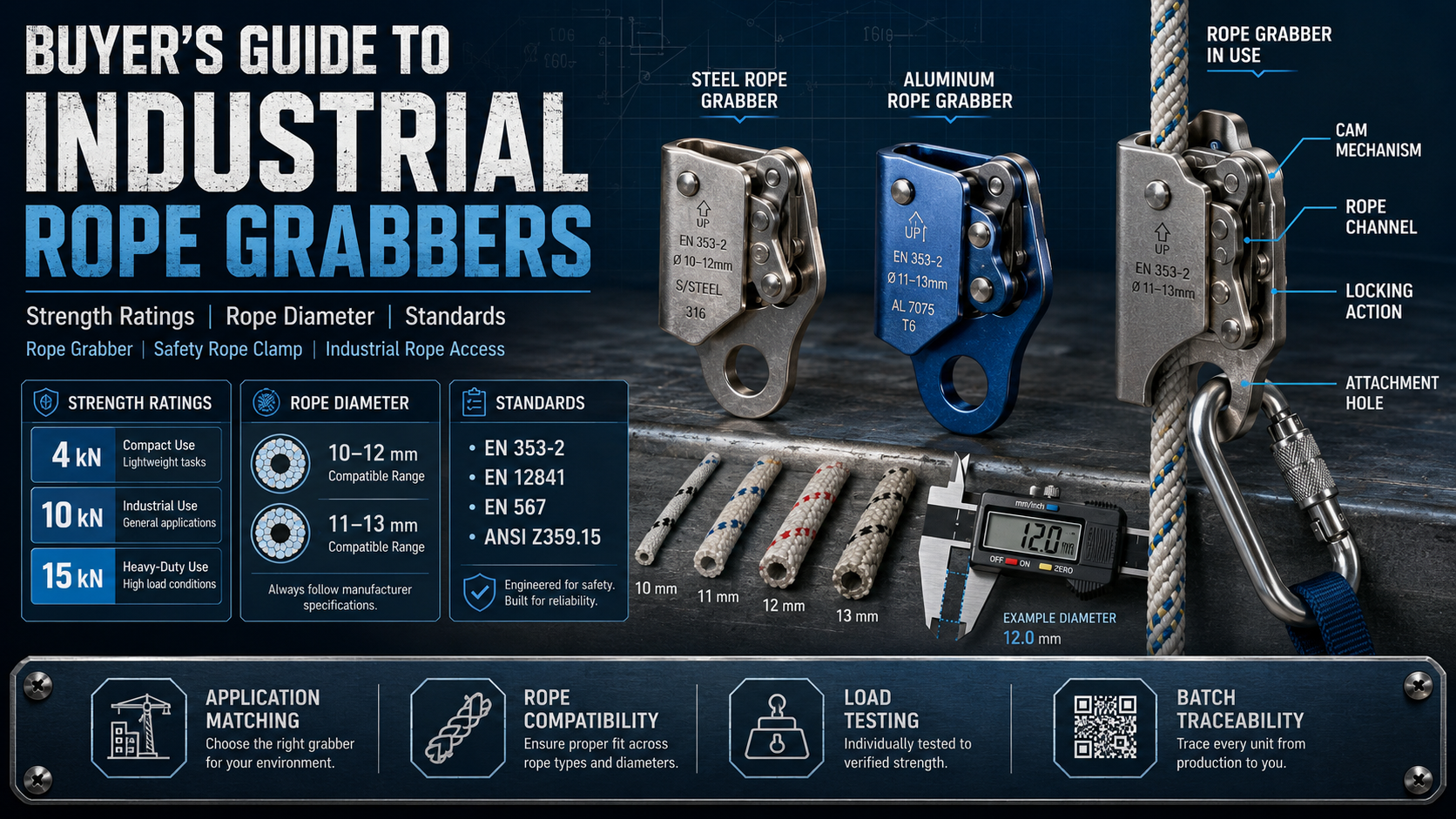
Industrial rope grabbers are widely used in fall protection, work positioning, rope access, rescue, climbing, and vertical lifeline systems. Their primary purpose is to interact with a rope and provide controlled movement, positioning, or locking when required.
However, not every device marketed as a rope grabber performs the same function.
The term “rope grabber” may be used for several different product categories, including manually operated rope clamps, rope adjustment devices, guided fall arresters, mobile fall arresters, and backup devices. Each category may follow different standards, use different locking mechanisms, and require a specific rope diameter and construction.
For safety harness manufacturers and B2B buyers, selecting a rope grabber based only on appearance, price, or a strength rating such as 4kN, 10kN, or 15kN can create serious compatibility and compliance risks.
This guide explains what industrial rope grabbers do, how to interpret different strength ratings, why rope diameter compatibility matters, which standards buyers should consider, and what information should be requested from a rope grabber supplier before placing an OEM order.
1. What Do Industrial Rope Grabbers Do?
A rope grabber is a mechanical device designed to engage with a rope. Depending on its design, it may move along the rope during normal operation and lock when force is applied in a specified direction.
The exact function depends on the product category.
Common Functions of Rope Grabbers
Industrial rope grabbers may be designed to:
Move along a vertical or inclined rope
Lock onto the rope when a sudden load is applied
Support work positioning
Assist upward movement
Act as a backup device in rope access
Connect a worker to a flexible anchor line
Help control movement during rescue operations
Prevent uncontrolled movement in a specified direction
Some devices move freely in both directions until a fall or rapid movement occurs. Others move manually and lock when the user releases the operating mechanism. Certain rope clamps are intended primarily for ascent and should not be used as fall arresters.
Rope Grabber vs Rope Clamp
The terms “rope grabber” and “rope clamp” are often used interchangeably in product listings, but buyers should not assume they describe the same function.
A basic rope clamp may be intended for:
Rope ascent
Equipment movement
Hauling systems
Positioning assistance
A mobile fall arrester may be intended to:
Follow the user along a safety line
Lock automatically during a fall
Work with an energy absorber
Form part of a certified personal fall arrest system
A rope adjustment device may be intended for rope access positioning or backup applications rather than general fall arrest.
The product name alone is therefore not enough. Buyers must identify the exact intended function, test method, compatible rope, connection method, and applicable standard.
Main Components of a Rope Grabber
A typical industrial rope grabber may include:
Steel or aluminum body
Cam or toothed locking mechanism
Pivot pin
Spring
Attachment hole
Opening plate
Safety latch
Rope channel
Connector interface
The geometry of the cam and rope channel is especially important. These parts must generate sufficient grip without cutting, crushing, or excessively damaging the rope.
2. Understanding 4kN, 10kN, and 15kN Rope Grabbers
Strength ratings are important, but they can also be misleading when they are not supported by a clear test description.
A rating of 4kN, 10kN, or 15kN does not automatically tell buyers:
Which part of the device was tested
In which direction the force was applied
Whether the test included a rope
Which rope diameter was used
Whether the value represents breaking strength
Whether it represents holding performance
Whether the device passed a dynamic fall test
Whether the rating is connected to a certification standard
For this reason, 4kN, 10kN, and 15kN should not be treated as universal industry classes.
They are better understood as product-specific strength values that must be reviewed together with the manufacturer’s technical documentation.
4kN Rope Grabbers
A 4kN rating may appear on compact rope adjustment devices, lightweight rope clamps, or products designed for limited-load applications.
Possible advantages include:
Lower product weight
Compact body design
Easier transportation
Suitable for specific adjustment or movement functions
Lower material consumption
However, a 4kN product should not automatically be treated as a fall arrest device.
Before approving a 4kN rope grabber, buyers should verify:
Its intended use
Whether it is personal protective equipment
Whether it is designed for positioning or ascent
Whether the rating applies to the body or complete system
The specified rope type and diameter
Whether dynamic testing has been performed
The relevant certification
A lower strength value does not necessarily mean poor quality. It may simply indicate that the device was designed for a different function. The key issue is whether the strength and performance match the intended application.
10kN Rope Grabbers
A 10kN rope grabber may provide a balance between weight, structural strength, and industrial usability.
Products in this range may be considered for:
Work positioning systems
Rope adjustment
Industrial rope access
Rescue support systems
Vertical movement applications
Backup or safety-line functions, when appropriately certified
For B2B buyers, a 10kN marking still requires careful interpretation.
Important questions include:
Is 10kN the minimum breaking strength?
Was the device tested with the gate or plate closed?
Was the rope included during the test?
Did the rope slip, tear, or become damaged?
Is the device certified for fall arrest?
Is an energy absorber required?
Is the device approved for one person or rescue use?
A rope grabber may have a strong metal body but still perform poorly if its cam geometry, spring force, or rope compatibility is incorrect.
15kN Rope Grabbers
A 15kN rope grabber is generally associated with a stronger or heavier-duty structure. It may be suitable for industrial environments where buyers require increased mechanical strength, steel construction, or resistance to demanding working conditions.
Potential applications may include:
Industrial vertical lifeline systems
Heavy-duty rope adjustment
Construction and maintenance
Tower climbing support
Rescue equipment
High-abrasion working environments
The higher rating may provide additional structural capacity, but it does not automatically make the device suitable for every fall protection application.
A 15kN rope grabber can still be unsuitable if:
The rope diameter is incorrect
The cam damages the rope
The device is installed in the wrong direction
The locking action is too slow
The connector is incompatible
The product lacks the required certification
The system requires an energy absorber that is not used
The correct product is not simply the strongest product. It is the device whose function, rope compatibility, performance, and certification match the complete system.
Strength Rating Comparison
| Rating | Typical Buyer Interpretation | Possible Product Positioning | Critical Verification |
|---|---|---|---|
| 4kN | Lightweight or limited-load device | Rope adjustment, ascent assistance, compact applications | Confirm that it is not being incorrectly used for fall arrest |
| 10kN | Medium-strength industrial device | Positioning, rope access, safety-line or adjustment functions | Verify test direction, rope compatibility and certification |
| 15kN | Higher-strength or heavy-duty device | Industrial access, rescue, construction and demanding environments | Confirm system performance rather than relying only on body strength |
These descriptions are general purchasing references, not universal classifications. The manufacturer’s test report and instructions must define the actual use of each product.
3. Choosing a Rope Grabber Based on Rope Diameter
Rope diameter is one of the most important selection factors for any safety rope clamp or rope grabber.
A rope grabber designed for an 11mm rope may not work safely on a 9mm or 13mm rope. Even when the device can physically be installed, its locking performance may change significantly.
What Happens When the Rope Is Too Thin?
If the rope diameter is below the approved range:
The cam may not engage correctly
The device may slide under load
Locking distance may increase
The rope may move through the device unexpectedly
The fall-arrest function may become unreliable
The device may rotate into an incorrect position
A thinner rope may also sit incorrectly inside the rope channel, reducing contact between the cam and rope sheath.
What Happens When the Rope Is Too Thick?
If the rope diameter is above the approved range:
The device may be difficult to install
The cam may remain partially engaged
Normal movement may become restricted
The rope sheath may be excessively compressed
The locking mechanism may not reset correctly
The device may cause premature rope wear
A rope that is too thick can also prevent the side plate or latch from closing completely.
Diameter Is Not the Only Rope Specification
Two ropes with the same nominal diameter may perform differently because of differences in:
Rope construction
Sheath thickness
Material
Stiffness
Surface texture
Elongation
Moisture condition
Dirt contamination
Manufacturing tolerance
Age and wear
For example, a new low-stretch kernmantle rope may behave differently from an older rope with a worn or fuzzy sheath.
This is why some certified rope grabbers are approved only with specific rope models rather than every rope of the same diameter.
Typical Rope Diameter Ranges
Industrial rope devices commonly use ropes within ranges such as:
8–11mm
10–12mm
10–13mm
11–13mm
12–16mm
These are examples only. The actual permitted range must come from the device manufacturer’s instructions and certification documents.
Questions Buyers Should Ask About Rope Compatibility
Before ordering, buyers should ask:
What is the approved rope diameter range?
Which rope construction is required?
Is the device approved for low-stretch kernmantle rope?
Must a specific rope model be used?
Has testing been completed with wet, dirty or cold rope?
Does the device work in both vertical and inclined configurations?
What happens to the rope during dynamic loading?
Is rope sheath damage evaluated after testing?
Is the device removable at any point on the rope?
Is an energy absorber required?
For OEM safety equipment manufacturers, the rope grabber and rope should be tested as a system rather than purchased as unrelated components.
4. Match the Device to the Application
Different applications require different rope-grabbing functions.
Vertical Lifeline Fall Arrest
For vertical lifeline systems, the device normally travels along a flexible anchor line and locks during a fall.
Buyers should evaluate:
Automatic following performance
Locking response
Required energy absorber
Fall distance
Rope compatibility
User weight range
Correct installation direction
Connector compatibility
A basic manually operated rope clamp should not replace a certified mobile fall arrester.
Industrial Rope Access
Rope access systems may use separate working and safety lines. Rope adjustment devices can perform different roles on these lines.
Depending on the system, buyers may require:
A backup device
An ascent device
A work-positioning device
A controlled descent device
Each role requires a different mechanical function. A chest ascender, for example, should not automatically be considered a backup fall arrester.
Work Positioning
A rope grabber used for work positioning may allow the worker to adjust position while maintaining controlled tension.
Important factors include:
Smooth adjustment
Reliable locking
One-hand operation
Rope protection
Compatibility with the positioning lanyard
Ease of inspection
The device should not create uncontrolled slack or damage the rope during repeated adjustment.
Rescue Systems
Rescue applications may introduce higher loads, additional users, or more complex movement.
Buyers should confirm:
Whether the device is approved for rescue
Maximum permitted system mass
Two-person capability
Rope diameter
Connection configuration
Backup requirements
Compatibility with pulleys and descenders
A device suitable for one worker is not automatically suitable for a worker and rescuer together.
Construction and Tower Climbing
Construction and tower environments often expose rope grabbers to:
Dust
Rust particles
Concrete residue
Rain
Oil
Abrasion
Repeated impact
Steel rope grabbers may offer strong wear resistance in these applications, but the surface treatment, spring condition, cam teeth, and opening mechanism must be inspected regularly.
5. Standards Industrial Rope Grabber Buyers Should Follow
The applicable standard depends on the device category, market, intended use, and system design.
There is no single global standard that applies to every product marketed as a rope grabber.
EN 353-2
EN 353-2 applies to guided-type fall arresters associated with flexible anchor lines.
Products in this category are designed as part of a fall arrest system. Buyers should review requirements related to:
Fall-arrest performance
Flexible anchor line compatibility
Dynamic testing
Marking
Manufacturer instructions
System configuration
A product claiming compliance should identify the compatible rope or flexible anchor line and any required connector or energy absorber.
EN 12841
EN 12841 addresses rope adjustment devices used in rope access systems.
Different device functions may be categorized according to how they interact with the working or safety line.
Buyers must determine whether the product is intended as:
A backup device
An ascender
A descender
Another rope adjustment component
An EN 12841 rope adjustment device should not automatically be assumed to perform every fall-arrest function outside its approved system.
EN 567
EN 567 applies to rope clamps used with specified types of mountaineering and low-stretch ropes.
Products under this standard may be used for rope ascent and related functions. They should not automatically be described as industrial fall arresters unless they also meet the requirements of the relevant fall protection standard.
ANSI/ASSP Z359.15
For the North American market, ANSI/ASSP Z359.15 covers single-anchor lifelines and fall arresters used in personal fall arrest systems.
The standard addresses areas such as:
Design
Performance
Qualification testing
Test methods
Marking
Instructions
Training
Maintenance
Removal from service
B2B buyers targeting the United States should confirm which revision applies to the product and intended system.
Local Regulations and Complete-System Requirements
Compliance with a component standard does not automatically make the entire system compliant.
Buyers must also consider:
Local workplace regulations
Harness requirements
Connector requirements
Anchorage strength
Energy absorber compatibility
User weight
Fall clearance
Rescue planning
Inspection procedures
The safest approach is to evaluate the rope, rope grabber, connector, absorber, harness, and anchorage as one complete system.
6. Materials and Manufacturing Quality
Industrial rope grabbers are commonly manufactured from steel, aluminum, or a combination of both.
Steel Rope Grabbers
Steel offers:
High strength
Good wear resistance
Strong cam durability
Resistance to deformation
Suitability for demanding industrial environments
Steel devices usually require appropriate surface protection, such as zinc plating, electrophoretic coating, or another corrosion-resistant finish.
Aluminum Rope Grabbers
Aluminum provides:
Lower weight
Good strength-to-weight ratio
Easier carrying during rope access
Corrosion resistance after anodizing
User comfort during long-duration work
Aluminum body components may still use steel cams, springs, pins, or axles in high-wear areas.
Manufacturing Factors to Check
B2B buyers should evaluate:
Material grade
Heat treatment
Stamping or forging quality
CNC machining accuracy
Cam tooth geometry
Spring consistency
Pin and rivet assembly
Surface finishing
Edge smoothness
Product markings
A rope grabber with an inaccurate cam profile may damage the rope or fail to lock consistently even if the metal body passes a tensile test.
7. Testing and Quality Inspection
Rope grabber inspection should evaluate both mechanical strength and functional performance.
Important tests may include:
Static strength testing
Dynamic locking testing
Rope slippage testing
Cam engagement testing
Rope damage inspection
Opening mechanism testing
Spring return testing
Corrosion resistance testing
Dimensional inspection
Repeated-use testing
Rope Damage Is a Critical Test Result
A device may lock successfully but still cause unacceptable damage to the rope.
After testing, inspectors should check for:
Sheath cutting
Severe glazing
Flattening
Core exposure
Excessive tooth penetration
Permanent deformation
The objective is not simply to make the device grip as aggressively as possible. The locking system must balance stopping performance with controlled interaction with the rope.
Batch Traceability
Professional suppliers should link finished rope grabbers to:
Raw material batches
Production dates
Heat-treatment records
Surface-treatment batches
Inspection results
Load-test reports
Packaging records
Traceability helps OEM customers manage certification, quality audits, complaints, and long-term supplier evaluation.
8. Buyer's Checklist for Selecting a Rope Grabber
Before approving a rope grabber supplier, ask for the following information:
1. Exact intended application
2. Product strength rating and definition
3. Test direction and test method
4. Compatible rope diameter
5. Approved rope type or model
6. Applicable standard and certification
7. User weight or system capacity
8. Required energy absorber
9. Material and surface treatment
10. Static and dynamic test reports
11. Rope damage evaluation
12. Installation instructions
13. Inspection and retirement criteria
14. Batch traceability
15. OEM customization options
Buyers should also test product samples with the actual rope, connector, harness, and system configuration planned for the finished product.
9. OEM Customization for Industrial Rope Grabbers
Safety harness manufacturers and rope access brands may require customized rope grabbers for different markets and applications.
Common OEM options include:
Steel or aluminum body
Custom rope diameter
Different strength targets
Modified attachment hole
Custom cam profile
Private logo
Product model marking
Batch traceability code
Surface treatment
Packaging
Technical documentation
Sample and load testing
Custom development should begin with a clear application specification.
The supplier should know:
How the device will be used
Which rope will be used
Required strength
Target standard
User weight
Connection method
Environmental conditions
Expected production volume
This information allows the manufacturer to evaluate tooling, material, structural design, and testing requirements before mass production.
Conclusion
Selecting an industrial rope grabber requires more than comparing 4kN, 10kN, and 15kN strength ratings.
Buyers must understand what the device is designed to do, how the rating was measured, which rope diameter and construction are approved, and which standard applies to the intended application.
A 15kN rope grabber is not automatically safer than a 10kN model, and a 4kN device is not automatically low quality. Each product must be evaluated according to its function, test method, system compatibility, and certification.
For safety harness manufacturers, PPE brands, and industrial rope access equipment companies, the best purchasing approach is to evaluate the rope grabber as part of a complete system that includes the rope, connector, energy absorber, harness, and anchorage.
Clear specifications, documented testing, compatible components, and reliable manufacturing quality are the foundations of safe rope grabber selection.
Call to Action
Request Our Industrial Rope Grabber Specification Sheet
Are you sourcing steel rope grabbers, safety rope clamps, or rope adjustment devices for fall protection, rescue, or industrial rope access systems?
Our rope grabber specification sheet can provide:
Available strength ratings
Compatible rope diameters
Product dimensions
Steel and aluminum material options
Surface treatments
Load-testing information
OEM marking options
Sample evaluation support
Contact us to request the Industrial Rope Grabber Specification Sheet, technical drawings, sample testing, or OEM customization support for your next project.